
Resources
Books and reflections on psychotherapy, psychoanalysis, grief, and the stories that shape a life.
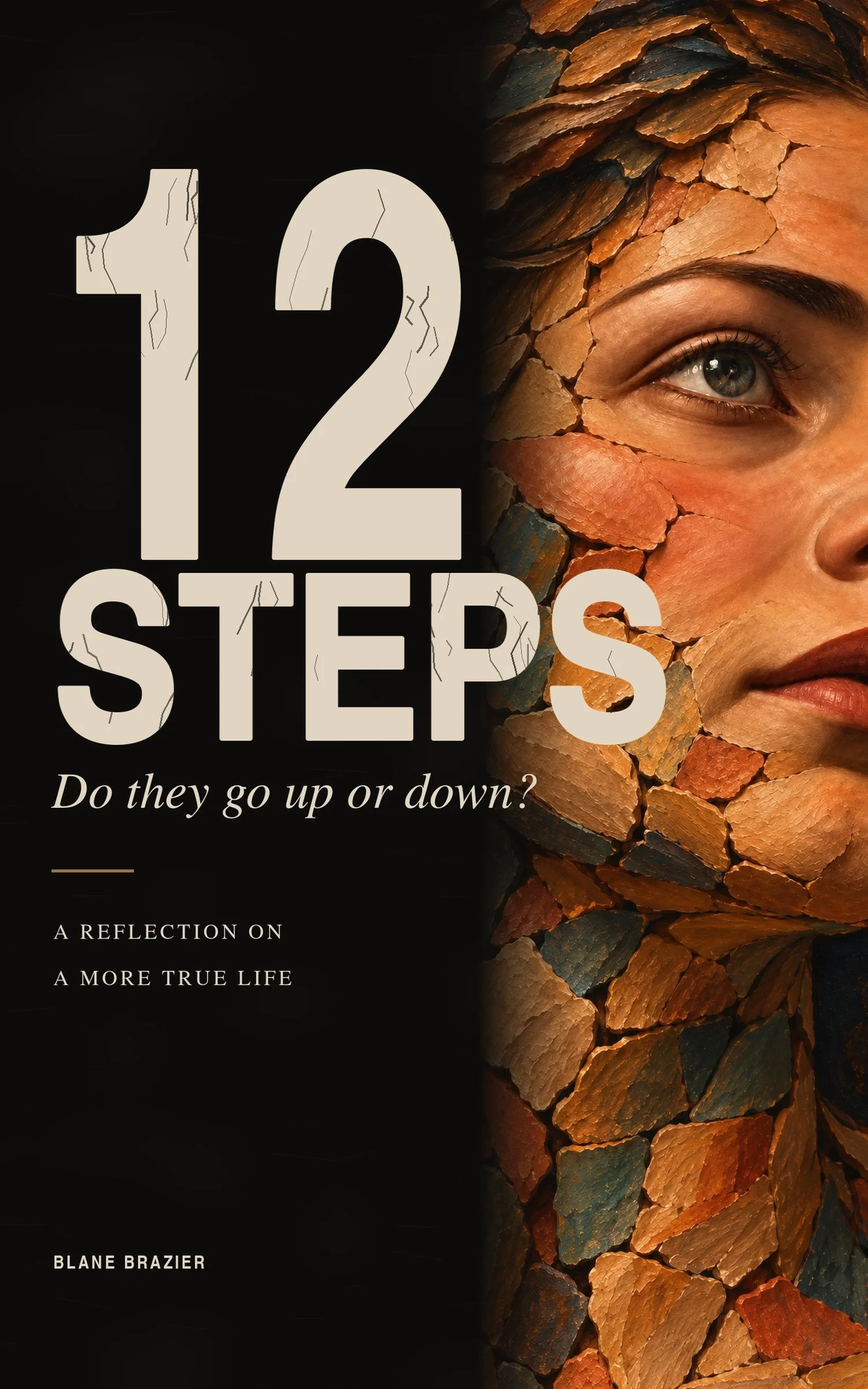
12 Steps: Do They Go Up or Down?
A reflection on a more true life.
What if the Twelve Steps are not a ladder toward becoming better, but a descent beneath the images we use to appear good? Drawing from Alcoholics Anonymous, psychoanalysis, and theological reflection, Blane Brazier explores recovery as the relinquishment of performance, righteousness, resentment, and the demand to be seen in a certain way.
Buy on AmazonFrom the blog
Read the latest posts below, or explore earlier entries through Older Posts.

When Trauma is Unspeakable
At Lost Stories, we use a variety of techniques and frameworks to help clients process their traumatic experiences based on the principle that each persons unconscious has a capacity to craft sublime poetry with infinitely intimate meanings. Vamık Volkan’s work on linking objects offers one way to consider how an object can carry a relationship that remains difficult to mourn. (Volkan, 1972)
Volkan, a Turkish psychoanalyst, explored how physical objects can become charged with a person’s relationship to someone who has died. These objects act as a bridge between our conscious and unconscious mind and can be used to access deep-seated emotions and memories.
In therapy, linking objects can be used to help clients process traumatic events or complex relationships through symbolic representations. The therapist may ask the client to identify an object that represents the traumatic experience or relationship and then use this object to explore the client's emotions and experiences.
For example, a person may bring a seashell that recalls both a particular place and a frightening experience involving water. That is an illustration, rather than a prescribed Volkan technique. The work would follow the person’s associations and pace, without requiring them to relive the event or find a meaning supplied by the therapist.
Linking objects can also be used to foster positive emotions and connections. For example, a client who has lost a loved one may choose a favorite photograph or piece of jewelry to represent that relationship. The therapist may encourage the client to talk about positive memories associated with the object or to create new positive memories by engaging in activities while holding or wearing the object. The work may also include demarcation, which is to use the object to set a boundary between the patient and the representation of the dead so that they ritualize a turn back towards life and its meaning.
Using linking objects in therapy can be a powerful tool for helping clients process complex emotions and experiences. At Lost Stories, we are committed to using a wide variety of established therapeutic techniques to help our clients achieve emotional growth.
An object can become a place to begin when words are difficult. As its meanings unfold in a listening relationship, an experience that was felt but unformulated may become more thinkable. (Stern, 1997)

The Reality of Religious Trauma Syndrome
Religion can be a source of comfort and community for individuals, and it also has the potential to lead to religious trauma syndrome (RTS). Religious trauma syndrome is a term given to describe the psychological and emotional damage that can occur due to involvement in a religious organization or system especially to those who have been punished for their identity.
Marlene Winell introduced the term religious trauma syndrome to describe difficulties associated with harmful religious environments and leaving them. It is a descriptive term, rather than a separate diagnosis in DSM-5-TR. Experiences described under it can nevertheless be serious and deserve individual assessment. They may include guilt, shame, fear, and difficulties with trust or identity. (Winell, Journey Free)
A person may feel deep guilt and shame around an identity or desire that their community has condemned. It may be difficult to separate a personal sense of self from the expectations of that community.
Trusting people outside the belief system may feel dangerous. Questioning beliefs can bring intense anxiety, while religious reminders may be associated with depression, fear, or distressing memories.
It's essential to understand that RTS is not merely a personal failure or weakness and may follow religious abuse, coercion, or exclusion. Religious trauma syndrome can be especially challenging because it can take so many forms that are more challenging to recognize.
Support should address the person’s particular fears, doubts, relationships, and symptoms rather than assume that everyone has the same injury or diagnosis. People experiencing RTS may need psychotherapy, group therapy, or trauma-focused types of therapy to recover.
In conclusion, harmful religious experiences can have a lasting impact. However, therapy and support groups can help those affected recover and process their experiences. Therefore, mental health professionals and Religious organizations need to collaborate to create safe spaces for persons to negotiate their beliefs and disentangle abusive religious systems safely. This is why Lost Stories is actively against systemic prejudice which means we are gay allied and anti-racist, committed to confront our own biases and micro-aggressive behaviors. At the core of our work is to give excluded stories, which are often lost stories in the larger societal narrative, the space they deserve in coming to know a truth that may make us all more free to associate. Come share your stories with us.

The Use of Transitional Objects in Mourning
Donald Winnicott was a British psychoanalyst who introduced the concept of transitional objects. According to Winnicott, transitional objects serve as a bridge between the inner and outer reality of an individual in an intermediate area of experience, neither simply an inner fantasy nor merely an external possession. In the context of mourning, a transitional object can help a person deal with grief and loss. (Winnicott, 1971)
Mourning is a process that involves the acceptance and understanding of loss. It is a time when individuals may feel overwhelmed by a range of emotions and may struggle to come to terms with their feelings. During this time, a transitional object can provide comfort and support.
Transitional objects can take many forms, but they are typically objects that provide comfort and familiarity to an individual. Examples of transitional objects include stuffed animals, blankets, or even photographs. In mourning, a personally meaningful object may serve as a physical representation of the connection between the individual and the person or thing that was lost.
For example, a person experiencing the loss of a loved one might cling to an item of clothing that belonged to the deceased. The clothing can function as a meaningful link because it is a physical representation of the connection between the individual and the person who has passed away.
In the context of mourning, transitional objects can help individuals cope with the emotions associated with grief and loss. These objects can provide a sense of comfort and familiarity during a difficult and emotionally challenging time.
In conclusion, Donald Winnicott's concept of transitional objects can be helpful for individuals experiencing grief and loss. Transitional objects can provide a bridge between the inner and outer reality of an individual and can serve as a physical representation of the connection between the individual and the person or thing that was lost. By helping individuals cope with grief and loss, transitional/linking objects can make the process of mourning more manageable and give symbolic insight into what lost object we seek in our mourning journey.
Winnicott’s transitional object and Volkan’s linking object are related points of reference, but they are not interchangeable terms. Not every keepsake is a linking object in Volkan’s sense. What matters is the particular use of the object, including whether it permits a relationship to change or holds mourning in suspension. (Volkan, 1972)

Dialectics of Depression in Mourning
Many know the Father of Psychoanalysis, Sigmund Freud, but not many know its “mother” - Melanie Klein.
Melanie Klein was a pioneer in psychoanalytic theory and helped shape the field of object relations theory. She is known for her work in developing psychoanalytic play technique to study infant development and her theory of the depressive position and mourning.
According to Klein, in the early stages of development, an infant experiences the world through splitting - idealizing and demonizing primary caregivers. However, as the infant grows, they begin to integrate the good and bad aspects of these objects to form a whole. This process is known as the depressive position.
The depressive position is a pivotal moment in development where the infant learns to cope with the ambivalence of loving and hating primary caregivers. It involves the ability to mourn the loss of an idealized object and move towards a more realistic perception of the object. Klein viewed mourning as an ongoing process in which individuals confront and work through the anxiety created by the loss of objects. (Klein, 1940)
Klein’s work on mourning has significant implications for understanding psychological distress. The depressive position is not a stage that someone completes once and for all; it is a capacity revisited throughout life. It concerns bearing love and hate toward the same person, and the guilt, concern, and wish for reparation that can follow. (Klein, 1940)
This is the dialectical quality I find in Klein’s account: mourning involves a relationship to both the good and bad aspects of significant others, rather than a demand to choose one picture. A parent may not have been everything we hoped, or everything we feared. Making that ambivalence thinkable can alter the authority of an idealized image. This is not advice to intensify depression or endure it without treatment. Clinical depression deserves careful attention.
Please take depressed feelings seriously and seek professional support if you are struggling or feel unsafe.
Klein, M. (1940). Mourning and its Relation to Manic-Depressive States. In Love, Guilt and Reparation and Other Works 1921–1945.

The Lost Object
Jacques Lacan was a French psychoanalyst who made significant contributions to the understanding of human psychology. His theories on the subject of desire provide us with an insightful view on the human mind and the way our experiences shape our desires. One of Lacan's most prominent developments is the objet petit a, which he conceptualized as the object-cause of desire, rather than a missing possession that could finally complete us. In my application to mourning, the loss may concern not only a loved person but the place their love or desire gave us in the world. (Lacan, 1964/1978)
Furthermore, Lacan believed that the superego plays an important role in the formation of desire. As discussed in the previous blog post, the superego is the part of our psyche that is responsible for creating a sense of morality and values that guide our actions. More than the ‘should not’s’ of superego, Lacan notes the ‘shoulds’ of the superego or ideals which give us some mapping to the desire of our lost objects. Lacan argues that the superego and what I call the fantasy of “missed blessings” creates a sense of guilt and anxiety in us by making us feel as though we are lacking or not doing enough.
This, in turn, can keep a person pursuing an imagined answer to what is lacking. The fantasy of filling that lack should be distinguished from Lacan’s account of objet petit a as the cause of desire. (Lacan, 1964/1978; 1972–1973/1998)
Finally, Lacan also highlighted the importance of the desire of the other in shaping our own desires. The desire of the other refers to the way we model our own desires after those of people we admire or view as authority figures. Their expectations can give shape to what we believe we ought to want, including desires that do not simply amount to imitation or conscious approval. Consequently, our desire is shaped by those around us, whether consciously or unconsciously.
Overall, Lacan’s theories on the objet petit a, the superego, and the desire of the other offer insight into why we desire certain things and what drives us to pursue them. How does this change how we mourn? Depression may be experienced as a loss of desire or feeling, though it cannot be defined by that experience alone. In mourning we journey to find the Object cause of desire and to find our desire again. In this kind of therapy, we can experience love less as filling a lack and more of a path to setting healthy limits in loving relationships so that one’s singularity is protected and maintained.
Lacan, J. (1964/1978). The Four Fundamental Concepts of Psychoanalysis: Seminar XI, translated by Alan Sheridan. W. W. Norton.
Lacan, J. (1972–1973/1998). On Feminine Sexuality, the Limits of Love and Knowledge: Seminar XX, translated by Bruce Fink. W. W. Norton.
Freud, S. (1914). On Narcissism: An Introduction. Standard Edition, 14, 67–102.

The Intersection of Guilt and Grief
In his paper on "Mourning and Melancholia," Sigmund Freud explores the concepts of grief and depression. Freud argues that mourning, or the natural grieving process after the loss of a loved one, involves a separation between the ego and the lost object. This describes a gradual response to the reality of the loss, rather than a timetable for forgetting the person. However, in the case of melancholia, the individual identifies with the lost object, and conflict with that object can become a severe attack on the self. Freud's paper suggests that mourning is a healthy and necessary process for healing after loss, and that therapy can help individuals struggling with melancholia to work through their unresolved grief. Overall, "Mourning and Melancholia" contributes significantly to our understanding of grief and depression and remains a widely studied and influential work in the field of psychology.
Freud’s account of self-reproach in Mourning and Melancholia also anticipates questions he later develops through the concept of the superego in The Ego and the Id. The two texts belong to different moments in his thinking. (Freud, 1917; 1923)
According to Freud, mourning is a natural and normal process that occurs when we experience the loss of a loved one. In contrast, melancholia is a distinct configuration of loss and identification that can occur when we experience a more abstract or intangible loss, such as the loss of a relationship or even the loss of our own identity. The lost relationship can become entangled with a profound sense of sadness, guilt, and despair.
Mourning can involve internalizing aspects of a person we have lost, including their values and the place their recognition held in our lives. This does not simply strengthen an internal moral compass. It may also expose the impossible standards by which we have learned to judge ourselves. (Freud, 1917; 1923)
When internal judgment becomes harsh, guilt and self-loathing may gather around not living up to the standards associated with the lost person. Some guilt concerns actual responsibility; some is organized around an image of the person we believe we should have been. Exploring that difference matters.
In conclusion, Freud's Mourning and Melancholia provides a valuable framework for understanding the connection between the process of mourning, the development of the superego, and mental health. The work is not to become a better mourner, but to hear more of the relationship, including the ambivalence that self-reproach can conceal.
Freud, S. (1917). Mourning and Melancholia. Standard Edition, 14, 237–258.
Freud, S. (1923). The Ego and the Id. Standard Edition, 19, 1–66.
Freud, S. (1914). On Narcissism: An Introduction. Standard Edition, 14, 67–102.

Grieving God?
How our Faith journey may be stuck in complicated grief
Grief is a complex and challenging experience for anyone to navigate, but complicating factors can further complicate the process. Spiritual grief is one such factor that can bring about such unique challenges and complexities.
Spiritual grief can arise when an individual experiences a loss intertwined with their belief system, faith, or spirituality. This loss can come in the form of losing a religious community, facing moral dilemmas, or loss of faith itself. Such a profound loss can lead to feelings of confusion, anger, guilt, shame, hopelessness, and disorientation.
In these cases, the person's spiritual practices may provide comfort, or they may trigger further emotional distress, causing them to question their beliefs, values, and purpose. It is not uncommon for individuals with complicated spiritual grief to feel isolated, misunderstood, or unable to connect with loved ones who may not share their beliefs or understand the depth of their grief.
Laurie Burke and colleagues have studied complicated spiritual grief, including struggles in a person’s relationship with God and with a religious community after bereavement. Their work recognizes that spiritual life may be a site of distress as well as a source of comfort. (Burke et al., 2014; 2021)
In therapy, there can be space to explore your relationship with faith, examine beliefs and values, and identify what has been lost. New practices or communities may become important, but they are not an obligation. The work is not about finding easy answers or quick solutions; it is about making room for the complexity of a person’s identity, beliefs, and desire.
An image of God may also carry expectations learned in earlier relationships: approval, disappointment, protection, or abandonment. This is the additional psychoanalytic question I bring to spiritual grief. What becomes difficult to say when the one who should offer comfort also seems absent or accusing?
Burke and colleagues’ Inventory of Complicated Spiritual Grief is a research measure of spiritual distress in bereavement; it is not a substitute for a clinical conversation. The linked papers describe its development and revision.
When does grief need therapy?
It all begins with an idea.
Losing a loved one or experiencing a significant life change can be an extremely difficult and painful experience. Grief is a natural reaction to these events, and it can take a toll on our emotional, physical, and mental wellbeing. Many people find their way through grief with personal and community support. Therapy can be useful when distress feels overwhelming, daily life is persistently affected, or there are experiences that have no other place to be spoken.
No two people experience grief in exactly the same way. It can be affected by a variety of factors, including our relationship with the person who has passed away, the circumstances of their death, our culture, and our own personal experiences. This complexity means that no one-size-fits-all approach to dealing with grief will work. A therapist can help clients navigate the complex emotions associated with grief and provide personalized advice, tools, and techniques to help them cope with their loss.
Grief can make it difficult to perform everyday activities, including work and socializing with others. It can be especially hard to continue with the normal routine when the person who has passed away played a significant role in one's life. A therapist can help clients develop healthy coping skills to prevent grief from interfering with day-to-day life.
Grief can have a profound impact on one's mental health, leading to depression, anxiety, and other mental health issues. A therapist can help clients identify the signs and symptoms of these conditions and provide the necessary guidance and support to get through these difficult times. (American Psychiatric Association)
Grief is a long process that can take years to fully navigate. Some may feel guilty about not moving on fast enough, not realizing that grief doesn’t have a timeline. It’s a process that one needs to work through at their own pace. A therapist who specializes in grief psychotherapy can provide ongoing support and realistic expectations for their clients during this process.
Grief can be overwhelming, and it can affect our minds and bodies in various ways. While it may be possible to cope with grief alone, seeking therapy can make the recovery process smoother for individuals struggling with grief. A therapist can help clients navigate the unique and complex emotions associated with grief, develop positive coping skills, and provide ongoing support during the long journey of healing.
The question need not be whether you are grieving correctly. It may be what remains difficult to think or say, including anger, guilt, relief, or wishes that do not fit the image of a good mourner.